

/ News, Research
Indistinguishable Photons from a Two-Photon Cascade
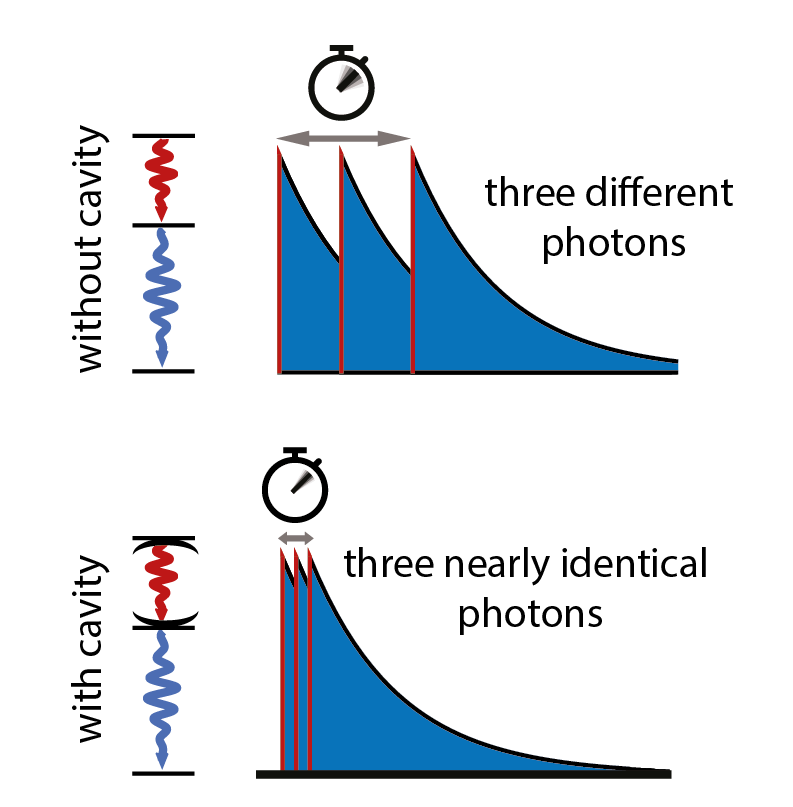
In a close collaboration, researchers from the University of Basel, Paderborn University and Ruhr University Bochum have demonstrated how special semiconductor nanostructures can be used to generate single photons and photon pairs that are almost perfectly identical. The results were published in the journal Physical Review Letters.
The biexciton decay has great potential…
In quantum information processing, photons are the ideal carriers of information. "The so-called 'biexciton cascade' in a semiconductor quantum dot emits photons on demand, which are highly interesting for modern applications. This is a process in which a quantum dot is excited twice and decays, generating two photons, one after the other," explains lead author Timon Baltisberger from the Nano-Photonics Group at the University of Basel. However, these photons face a challenge: to use them for complex calculations, they must have exactly the same properties – a characteristic known as "indistinguishability." Until now, such sources suffered from the fact that the photons generated were temporally correlated, which greatly reduced their indistinguishability and thus their quality. A team of doctoral researchers from Basel and Paderborn has now solved this problem by deliberately modifying the behavior of the quantum dot within an optical resonator.
… and can also generate identical photons
“A quantum dot is often described as an artificial atom within a semiconductor that can generate individual particles of light. By integrating it into a specialised optical cavity – similar to that found in a laser – the light emission process was specifically accelerated and controlled in this study,” explains Prof. Dr Stefan Schumacher, head of the ‘Theory of Functional Photonic Structures’ research group at the Department of Physics and the Institute for Photonic Quantum Systems (PhoQS) at Paderborn University.
Over the past years, Prof. Richard Warburton's research group at the University of Basel has intensively investigated the interaction of these quantum dots with optical cavities and achieved groundbreaking progress in various areas. The researchers were now able to apply this expertiseto the bi-exciton to deliberately accelerate its decay in a controlled manner. This results in photons of much higher quality: such photons achieve 90% indistinguishability, whereas without this effect it is only 60% – a marked improvement. The results show excellent agreement with theoretical predictions and point the way toward generating photons with even higher indistinguishability. "These results demonstrate that the biexciton decay can generate photons of very high quality – when the system is properly controlled with a cavity," says Prof. Warburton.
Purity is adjustable
The joint work with Dr Arne Ludwig from Ruhr University Bochum also provided deep insights into the underlying physical mechanisms. “We have found that the purity of the photons generated can also be optimised using the resonator and is limited only by vibrations in the semiconductor’s crystal lattice (phonons). This phenomenon, known as ‘cavity feeding’, must be taken into account in future designs and can then be systematically minimised even further,” explains Prof. Dr. Klaus Jöns, head of the ‘Hybrid Quantum Photonic Devices’ research group at the Department of Physics and the Institute for Photonic Quantum Systems (PhoQS) at Paderborn University.
The more indistinguishable and purer the photons generated are, the lower the error rate in data processing. Quantum dots are regarded as a promising technology for the mass production of such photons.
Quick Links