

/ News, Research / Oliver Morsch
Light engines in the quantum world
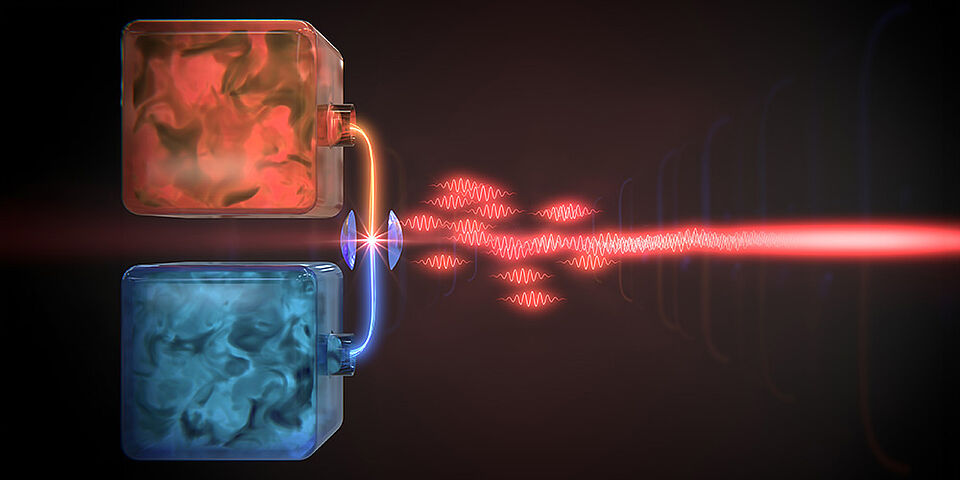
An atom in a cavity between two mirrors (left) acts as a heat engine in a driven-dissipative quantum system in which energy is continuously added and lost to the environment. The fluctuations in the escaping light (centre) are reduced (right) if only the atom but not the light is described quantum mechanically. (Illustration: Enrique Sahagún, Scixel, University of Basel)
What is heat, and what is useful work if a machine consists only of an atom and light particles? In modern quantum technologies, this kind of question connects thermodynamics with quantum physics. Researchers at the University of Basel have developed a theoretical approach that can reconcile both theories.
Quick Links